
Gardening Tips & Advice
Burke Nursery & Garden Centre is proud to provide funding for
Gardening with Burke Nursery,
hosted by Horticulturalist Misty Kuceris.
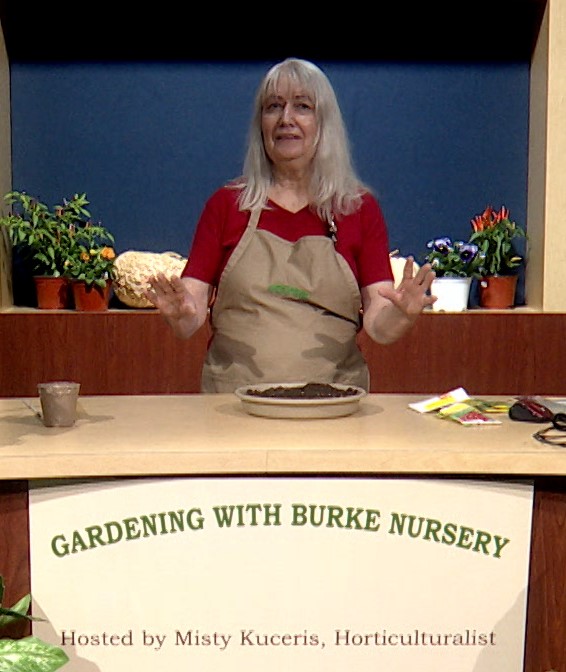
Misty Kuceris Horticulturalist
The show airs on Fairfax Public Access, Channel 10, on the first and second Tuesdays of the month at 7:30 am; the first and second Thursdays of the month at 7:30 pm; and the first and second Saturdays of the month at 2:00 pm.
To see a list of the episodes currently available on YouTube, just go to Gardening with Burke Nursery on YouTube.
Burke Nursery is here to help you grow your garden and improve the curb appeal of your home.
Survey your home paradise with pride. The garden with its annual and perennial flowers exudes color and texture while attracting birds and butterflies just as you planned. Trees and shrubs define your outdoor living space and are located just where you want them to be. The lawn is lush green and the envy of the neighborhood due to all the care you’ve given it. You’re proud of your home and you have every right to be: This is what you have achieved!
In addition to providing top quality plants, trees, shrubs, and gardening accessories, Burke Nursery & Garden Centre provides expert guidance to help you create your paradise.
- Planting annuals and perennials
- Planting trees and shrubs
- Different types of mulch
- Burke Nursery and Garden Centre Can Also Do the Planting
Looking for shade annual plants that you can substitute for impatiens this year? Just go to Plants to Substitute for Impatiens
General tips before you get started
Knowing your property is important. Before you do any planting, walk around your yard and notice whether the area you want to plant is full sun, partial sun, partial shade, or full shade. Full sun means six (6) or more hours of sun in the location. Partial sun means 4 hours of sun in the afternoon hours while partial shade means 4 hours of sun in the morning hours. Full shade can be created by trees, fences, houses, or other structures.
Planting annuals and perennials
Annuals are the plants which come up for only one year and provide color in your garden from spring through fall. The exceptions are your fall plants, such as pansies, which provide color in the fall, retreat into dormancy in the winter, and revive to provide more color in the spring until the heat of the sun which usually occurs in June.
Perennials are plants which come up every year. While they may only provide flowers for about three to six weeks during their growing season, the leaves stay green from spring through fall and create a wonderful backdrop and texture to the annuals in your garden.
To plant either annuals or perennials, you simply take them out of the pot, loosen the roots gently, and place them into the ground at the same level they were planted in the pot. Make certain that you add fertilizer to the ground before you plant them. You can either use a slow-release fertilizer which lasts for about four months, or you can use a traditional or organic fertilizer which might need to be reapplied every three to six weeks. The traditional or organic fertilizer really increases the flower of the annual plants while the slow-release fertilizer increases the strength of the perennial plants.
You may need to amend your soil before you plant. The soil amendments increase the nutrients or your soil and attract more worms. There are a wide range of soil amendments you can choose from, such as leaf compost, cow manure, or mushroom compost. If you need to add a soil amendment, only add about two inches and mix it into the existing soil.
Once you finish planting your garden, place down mulch. Annuals prefer only about one inch of mulch while perennials prefer two inches of mulch. Never place more than two inches of mulch around any plant.
Virginia is known for its clay soil so planting trees and shrubs is a little different in this location. When you decide where you want to plant, just dig a hole that is double the size in width from the container or root ball of the tree or shrub. Dig the hole only deep enough to rest the base of the tree or shrub in that hole so that two inches of the root ball is above the ground. Before you put the tree or shrub into that hole, take the soil you dug out and mix soil amendment, such as humus or compost, into the soil. Don’t mix more than 25% of the soil amendment into the existing soil. Once that’s done, place the tree or shrub into the hole and replace the soil. If your plant comes as a bag and burlap (B&B), be sure to cut the strings off the burlap. If the wrap is plastic, make certain to remove the plastic.
Once you finish planting, place no more than three inches of mulch near the base of the tree or shrub. Keep the mulch at least two inches away from the trunk.
To keep your new transplant growing, water it at least once a week for a year, unless the temperature is above 90 degrees or the plant is a Helleri holly, azalea, or barberry. If the temperature is above 90 degrees, or the plant is a Helleri holly, azalea, or barberry, water it twice a week. The easiest way to water is to place a hose at the base of the plant and let a slow trickle of water run. Leave the hose at the base of a shrub for about 30 minutes and at the base of a tree for about 60 minutes. Applying a starter fertilizer (5-10-5) will also help the growth of your new plant.
Mulching your garden beds, as well as around trees and shrubs, helps keep the weeds out and the soil at the proper moisture and temperature. Mulches from organic matter come in a wide variety. Even some forms of soil amendment can be used as mulch. Your most common mulches are:
- Shredded hardwood mulch. The most common form of mulch, it is a by-product of lumber yards. As it decomposes, it provides important nutrients to your soil that increases the amount of micronutrients and worms in the soil.
- Pine mulch. Pine mulch comes in many forms: shredded and nuggets. This mulch is often called softwood mulch and increases the acidity of your soil. This mulch is especially good around azaleas, rhododendrons, and other acid-loving trees and shrubs.
- Cedar mulch. Cedar mulch comes in three colors, red, black, and natural. Often used to create more landscape interest, universities studies have found that cedar mulch can kill odorous and Argentine ants and their nests.
- Cypress mulch. Called the floatable mulch because of its porous nature, this mulch is great for hills and slopes.
Burke Nursery & Garden Centre can do the planting
Burke Nursery & Garden Centre has an expert installation crew which can do the planting for you. Plantings include soil amendments and mulching around the tree or shrub, Trees and shrubs planted by Burke Nursery& Garden Centre, with the exception of sale items, have a one-year, 100% one-time replacement warranty.
![pumpkin[1]](/wp-content/uploads/2013/03/pumpkin1.png)
![197454109[1]](/wp-content/uploads/2013/03/1974541091.png)


